
Thrust Project
Design in the Kitchen
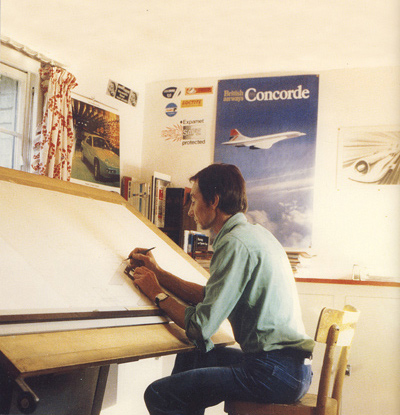 It made sense to design and build the car on the Isle of Wight.
I had a home there and a network of skilled contacts. Enfield Marine had left Ranalagh Works on Fishbourne Creek, and it had been taken over by three good friends. Ernie Sims, who had managed Enfield Marine, carried on building aluminium boats under his own name, Tony Peters, an apprentice with me at Saro ran a steel fabrication shop, and Mike Horne, another ex- apprentice, ran a fibre glass boat building yard. Ranalagh was the obvious place to set up shop and build Thrust 2.
The works were down a narrow potholed lane ending in a cluster of boat sheds with slips into the creek. In the middle of the sheds was a large semi-derelict house that had once been an elegant waterside home. The kitchen had an outside door, fitted cupboards and a fluorescent light, so I rented it from Tony Peters for £5 a week, and installed a large drawing board, borrowed from Tony in the deal.
In May 1978 Project Thrust opened its Island headquarters. The early days in the kitchen were not easy. The nearest telephone was a call box a quarter-mile and a stack of coins away. The photocopier was in Ryde six miles away, and printing a drawing meant a fourteen mile round trip to Westland Aerospace in East Cowes. An early model Audi 100 had replaced the Land Rover, but to keep overheads down I used my big black Hercules bike whenever possible. The old bike was soon dubbed my company car. In May 19781 got down to serious work. The starting point for the design was already fixed by the acquisition of the Rolls Royce Avon 210 jet engine, complete with afterburner, from Britain's first Mach 2 (twice the speed of sound) fighter. The Avon was 25ft long, weighed in at 3,800 pounds and pushed out 16,800 pounds of thrust.
The engine and all the other vital components such as driver, fuel tanks, wheels, suspension and drag chutes had to be arranged in the optimum layout to suit many conflicting interests such as safety, frontal area, visibility, weight distribution, stability, accessibility, and, not least for us, cost and ease of manufacture in a basic workshop. All the component parts had to be wrapped up into a slippery aerodynamic shell.
Having seen footage of the tragic Cobb and Campbell water speed accidents, and the wreckage of an assortment of land speed tragedies I was very aware of the need for safety in an inherently dangerous game. As the sole designer, the driver's life would be in my hands, and if I got it wrong all the armchair critics, armed with hindsight, would point the finger. The car would have to be built to the highest standards of safety and quality. It is too late to have niggling doubts when the car is winding up on the start line with a man inside it.
From the melting pot of all these considerations Thrust 2 took shape as a 27ft long monster with wheels, cockpits, fuel tanks and drag chutes housed in side bodies either side of the central engine pod. The driver sat on the right hand side, with a passenger (or camera) cockpit on the other side. His forward visibility would cover the track and there was enough bonnet to aim his missile down the course. The controls consisted of an accelerator pedal with a kick down for the afterburner, a brake pedal and a steering wheel with drag chute release buttons.
A record car must be right first time – it is both prototype and final product. To prove that we were on the right track it was decided to build Thrust 2 in two stages. Stage 1 would be a 'barebones' car without the final bodywork fitted, running on rubber tyres that we could take up to 260mph on British runways, to prove the basic systems, familiarise the team and get some publicity. Stage 2 would be dressed up in full record regalia, with sleek aerodynamic bodywork, a more powerful Avon 302 engine, and solid aluminium high speed wheels for use on lake bed surfaces.
In the Ranalagh kitchen I made a start by making a general arrangement (GA) drawing of the whole car with the components in place. From this I could make a detailed space frame drawing with the integrated driver's cage and all the mounting points. The drawing was posted to Ken Sprayson at TI so he could get started on the actual frame which would provide the basis of the car build.
Next on the list was a wind tunnel model urgently needed to establish the performance and stability of the design. Would it stay on the ground, or fly? Would it steer in a straight line? How fast would it go? Could it be a record breaker? I drew an accurate one tenth scale model and gave the drawings to Ivan Southcott, a local pattern maker. Ivan turned out a beautiful model, which Richard and I took to the British Aerospace wind tunnel in Filton. The results of the tests were encouraging, and showed that the car was stable and had record potential. I was relieved, as Ken Sprayson was forging ahead with the frame and any major changes would have been embarrassing.
Shut away alone in the kitchen I embarked on a drawing spree. Suspension, solid wheels, fuel tanks, seats, controls, steering, drag chute containers, every tiny bit of the car had to be drawn and made, there are no 'off the shelf' components for a land speed car. Working in solitary confinement I sometimes wondered if I was some kind of a nutter, living out a crazy fantasy. 'Oh, so you're designing the world's fastest car in that grotty kitchen with the old bike parked outside, are you?' My occasional visitors like Bryan the GQ seat belt and parachute man looked through the relevant drawings and still kept a straight face, so I pushed on regardless.
Towards the end of the year I was also producing quite a few letters and technical reports for suppliers and sponsors who we hoped would support us. My hand-written requests, and half- finished phone calls when the coins ran out, could be less than convincing. It was time to improve my image. Cycling along the coastal footpath to Ranalagh I saw a notice in an old stone cottage window, 'Typing and secretarial work undertaken'. I leaned the bike against the wall and knocked on the door. The good lady invited me in and gave me a cup of tea, while I explained that we were building this jet car down the lane and needed some typing done. It was agreed that I could drop off work on the way home and pick it up in the morning – my future reports would look a bit more professional.
By the end of 1978 Ken Sprayson had finished welding up the frame in Birmingham and the basic design was frozen. It was time to start building the car.
Next Page


