
Thrust Project
Afterburn & Airshows
1980 would be a year of reckoning. All the design theories, hard work, skill and enthusiasm would be put to the test. Thrust 2 would have to run under power and prove her worth. The Ranalagh team had to finalise the interim build with all the systems that would make the car go, stop and handle up to the 250mph speed limit imposed by the tyres. Thrust would have to use aircraft runways which would leave little margin for error, particularly on the drag chute and wheel brake system.
The Avon engine needed some vital components before it could be fired up. Noble heard that there were some obsolete Lightnings scattered round RAF Coningsby in Lincolnshire. The grounded fighters were used as decoys – sitting ducks – and could be a source of donor parts. The RAF agreed to sell Project Thrust the necessary parts as long as we dismantled them ourselves and left the airframe intact. One of the grounded fighters was duly moved into a hangar and the team burned the midnight oil extracting the critical organs for transplant. John Watkins was our RAF liaison man at Coningsby and he gave the team invaluable advice and hands on help.
By June the monster was up on its wheels ready to leave Ranalagh and breathe fire in Coningsby. Thrust 2 was rolled out of the creek-side shed and loaded onto its modified transporter provided by Crane Fruehauf along with driver, Terry Hopkins. Terry threaded the unwieldy combination up Fishbourne Lane and headed for Lincolnshire. Thrust must have felt at home on the Coningsby base, surrounded by fighters that shared the same engine. The jet car was fuelled up and lashed down. Tony Meston, Jeff Smee and John Watkins were in their element, as they fussed over the engine, adjusting, checking and double checking. Finally they were satisfied.
The starter unit looked like an overgrown vacuum cleaner on wheels. It was in fact a Palouste gas turbine engine that directed air down a hose into the air starter on the nose of the Avon. Gordon Flux fired up the Palouste and with a belch of flame it howled into life. The hose went rigid as the high pressure air flowed and the Avon started to turn. With eyes on the rev counter Tony Meston opened the throttle and the Avon lit. Gradually the throttle was opened to full power and at 8000rpm the afterburner was selected. Neat fuel sprayed into the tail pipe and ignited into a blast of flame that shook the ground and tortured the ears. Eight tons of thrust strained to break free of the lashing cables. Next week at Leconfield we would give Thrust her head and let her off the leash.
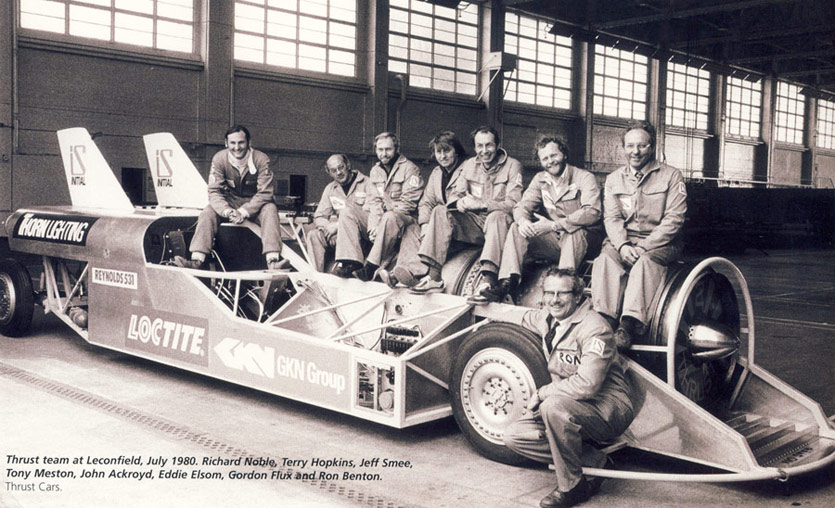
The one-time fighter base of Leconfield had been taken over by the army to train transport drivers on the runways that were now festooned with traffic lights and obstacles. The Army had given Thrust permission to use the runway as a proving ground for our powered trials. We were allocated slots between the Army training sessions. It was not an easy place to put an untried jet car through its paces, but Richard managed to 'jump the lights' at 170mph. The car worked and Richard could control it, but he needed long uncluttered runways to engage the afterburner and pile on the power.
He was to get plenty of opportunities. Thrust 2 was booked into the summer air show circuit as a prime attraction. The air shows were a way to prove the car, earn some cash, familiarise the crew and raise dramatic publicity for the sponsors. Meanwhile we had to make progress with the next stage of transforming our rolling chassis into a sleek record breaker. It was back to the drawing board for me.
As the speed builds up over 550mph into the transonic region the drag goes up by leaps and bounds. We had to know what the drag rise was and if Thrust would have enough power to overcome it at 650mph. A transonic wind tunnel model would tell us. Albert Nobbs machined a 1/30th scale model out of solid aluminium. The model was tested in the transonic tunnel at British Aerospace in Weybridge and indicated that the drag rise was less than we feared and that Thrust had the potential for 650mph. Because the tunnel could not replicate the car moving over the surface, it did not tell us what lift or down thrust we might expect. Would the car take off or bury itself in the lakebed? The only reliable answer would come from the car itself.
We would instrument the front suspension, measure the load on the front wheels and record it on a data logger. Speed would be built up in steps and the loading plotted so we could predict if the front of the car was getting lighter or heavier, with lift or down force. If the front was getting light we could jack the back of the car up on the suspension to push the nose down or vice versa.
Assured by the transonic tests I ploughed on with drawings for the flush body panels, under tray, cockpit canopies and screens. The engine air intake and nose fairing was a complex shape of compound curves that would require lofting out full size. It was a big job and I needed a loft table. My mind went back to the Enfield days. What had happened to the table on which we had lofted the electric car? I headed for Somerton where Enfield were still producing industrial engines, and found the manager. The Enfield Automotive section of the old hangar was deserted, but upstairs there was the loft table, dusty but intact. 'Yes of course you can use it,' said the manager. I moved in with an assortment of antique smoothing irons to use as spline weights and started work amongst the ghosts of electric cars. The nose of Thrust was as big as an electric car, and more complex, but with no distractions progress was good, and I ended up with a 'full set of lines'. The lofts were delivered to Ivan Southcott at his pattern making shop in Ryde. He had already made the first wind tunnel model, and now had to convert a maze of lines into full size patterns and formers.
While I was preparing the ground for the next stage, Richard and the team were putting on an ever faster and slicker performance at the airshows, with dramatic afterburner and drag chute deployments. However the finale was not to be a public spectacle but a serious team affair.
Project Thrust had managed to get the use of the high security Greenham Common Air Base with the longest runway in Britain. The base was on a standby footing so Thrust 2 and the team would have the runway to themselves. The plan was to break the British National Land Speed Record then held by Richard Horne in a Ferrari at 191mph.
Although there are numerous class records, the outright Land Speed Record (LSR) is the fastest over the flying mile or kilometre. The rules are simple. The record is based on the average speed of two passes in opposite directions over a measured mile. Both passes must be made within an hour. This means the measured mile must be in the middle of the course, so the crew have to be well practised to turn the car round, fuel up, inspect the tyres, load new chutes and then send it back within the hour.
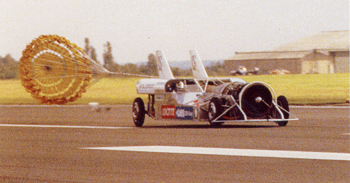
In September, Thrust 2 and the full team arrived at Greenham and got down to trial runs. I was lucky to get a fast test run in the passenger seat. Richard had to drive within very fine limits. The runway was only two miles long with the measured mile in the middle. That left half a mile for acceleration up to speed, and then half a mile to stop. We parked a van 500 feet from the end of the mile. Richard needed to release the chute as he passed the van in order to stop just feet from the end of the runway. In two hectic days on the 24th and 25th September Richard and Thrust 2 broke six British national records including the flying mile at 248.87mph. Considering the tyres were limited to 250mph it was close to bone!
The fun was over. Thrust 2 and the team had been 'on the road' for three months. It was time to bring the car home, put it back in the shed and get cracking. There was an enormous amount of work ahead to turn our ugly duckling into a fully fledged swan. The engine had to be changed for a more powerful Avon 302, a whole new body had to be fitted, formers and moulds had to be made for the intake, the cockpit had to be fitted out, instrumentation and a data logger had to be installed. The list went on and on. Tony Meston had to leave us and get on with his flying career. John Watkins would help us with the engine when the RAF could spare him. Mike Barrett and Phil Goss joined the team on the metal work.
A high speed drag chute system was desperately needed. It would be a lifeline as well as a braking system. If Thrust 2 had a failure or got out of control the drag chute could be released to straighten the car out and prevent a tumbling accident. With a target of 650mph we had to have chutes which could be deployed at that speed and survive. 'Bruce the Chute' White from Irvin Parachutes found the answer; expired atomic bomb deceleration chutes. To get the chute up into clean air above the car's wake I would have to design a 'mortar' fitted to the back of the car. The mortar fired a projectile that would pull the chute up and away for a clean opening.
We now had a full team and a deadline of Summer '81 for a fully finished record contender. The expanded team and overheads put an even bigger burden on Richard's fund raising. The Project had hit the headlines but to keep the cash coming in was a task that would daunt anyone without Richard's drive, and optimism. The list of contributors and sponsors grew day by day, but we still had to watch every penny.


